The Great Gallery and other
Rock Art in Horseshoe Canyon
View more and bigger photos
By Dave Webb
 I awoke with the first light of dawn, a bad habit
I’m trying hard to break. Unsuccessfully in my attempts to return
to dreamland, I lingered in my comfy mummy bag, hesitant to scramble out
because I knew the winter air would be nippy. I unzipped my tent door
and watched as the sky turned a pale apricot color. The hues deepened
and soon the entire sky and nearby cliffs were aglow with a soft, salmon-colored
light, harmonious across the entire visible world. It was a spectacular
show – it alone would have justified the trip. Dawn in the desert
is a mystical time.
I awoke with the first light of dawn, a bad habit
I’m trying hard to break. Unsuccessfully in my attempts to return
to dreamland, I lingered in my comfy mummy bag, hesitant to scramble out
because I knew the winter air would be nippy. I unzipped my tent door
and watched as the sky turned a pale apricot color. The hues deepened
and soon the entire sky and nearby cliffs were aglow with a soft, salmon-colored
light, harmonious across the entire visible world. It was a spectacular
show – it alone would have justified the trip. Dawn in the desert
is a mystical time.
We broke camp and quickly descended into a shadowy
chasm full of wonder and mystery. Each step took us back into pre-history,
to a time before "The Ancient Ones." Our destination: the Great
Gallery in Horseshoe Canyon.
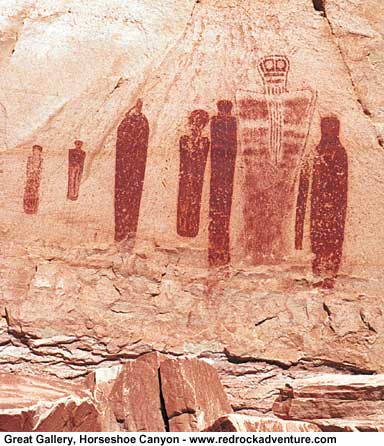
I’ve seen countless photos of the Gallery
and so I knew what to expect. Still, a shiver ran down my spine as I rounded
a bend and suddenly realized huge, ghostly figures were staring at me.
Eerie humanoids. Some, undoubtedly gods or great ones, standing 10-feet-tall
with animals and special symbols incorporated into their robes. Some without
arms or eyes. Others with large, unblinking eyes, watching over the canyon
sanctuary.
Edward Abbey captured the feeling in his work,
Desert Solitaire. "These are sinister and supernatural figures,
gods from the underworld perhaps who hover in space, or dance, or stand
solidly planted on two feet carrying weapons – a club or sword. Most
are faceless but some stare back at you with large, hollow disquieting
eyes. Demonic shapes, they might have meant protection and benevolence
to their creators and a threat to strangers: beware, traveler, you are
approaching the land of the horned gods...."
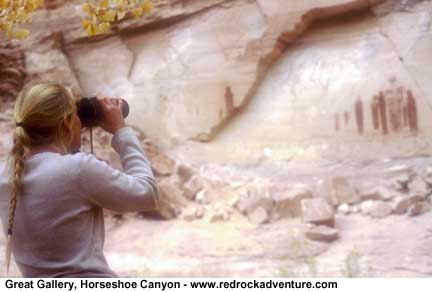 We
sat quietly and stared at the panels of ancient rock art, noticing more
and more of the intricate detail with each passing minute. Noticing but
not comprehending. Each new detail brought unanswerable questions: Who
created this artwork? Why here, in this fortress-like canyon in this remote
and rugged extension of Canyonlands National Park, far from any oasis
deemed habitable by modern man? What did the figures mean to their creators? We
sat quietly and stared at the panels of ancient rock art, noticing more
and more of the intricate detail with each passing minute. Noticing but
not comprehending. Each new detail brought unanswerable questions: Who
created this artwork? Why here, in this fortress-like canyon in this remote
and rugged extension of Canyonlands National Park, far from any oasis
deemed habitable by modern man? What did the figures mean to their creators?
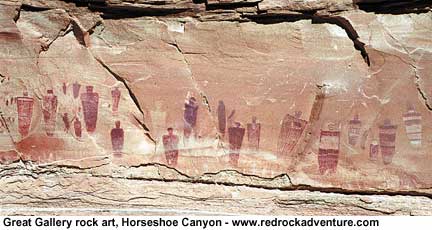
Barrier Canyon (now called Horseshoe Canyon) rock
art is considered by many to be the most significant in North America.
It sets a style and standard by which other rock art is evaluated. To
protect the site while allowing public access, Horseshoe Canyon was added
to Canyonlands National Park in 1971.
The canyon has been used by many people over thousands
of years and it shelters art from various periods. But the dominant work
– including that in the Great Gallery – is attributed to the
Archaic culture and dates back to 1,000—2,000 B.C. That was long
before the prehistoric Anasazi or Fremont or any modern tribe entered
the region.
The Great Gallery is on my list of must do adventures.
It’s a relatively short hike of moderate difficulty over a well-marked
trail. It’s suitable for families or youth groups. It can make a
wonderful hike for Scouts if leaders first educate the kids about the
significance of the place. It’s vital they learn not to deface or
even touch the rock art panels.
The hike is enjoyable – it would be a fun
outing even without the rock art. The canyon is scenic, with sheer slickrock
walls, an intermittent stream, a forest of cottonwood trees, many other
plants and a variety of animals.
Camping
 Camping
is not permitted in the Horseshoe Canyon part of Canyonlands National
Park. Camping is allowed at the trailhead and on BLM ground near the rim.
A vault toilet is provided at the trailhead. No other services are available
and there is no fee to camp. Camping
is not permitted in the Horseshoe Canyon part of Canyonlands National
Park. Camping is allowed at the trailhead and on BLM ground near the rim.
A vault toilet is provided at the trailhead. No other services are available
and there is no fee to camp.
The trailhead is acceptable as an overnight camp
spot if your intent is to get an early start hiking the canyon. It’s
not a great spot for other activities. There are no trees – no shade
or firewood – and it’s not a great place for late-night kid
games. Sand dune areas along the access road provide better spots for
longer camps.
Getting There
The trailhead is located some 32 miles
east of Hwy. 24, via a maintained dirt road. The road can usually be traveled
in a passenger car but may be rough with deep ruts, especially after storms.
The turnoff is signed and is located just south of the Hwy. 24 Goblin
Valley turnoff. This dirt road also provides access to the Maze District
of Canyonlands and to the Hans Flat Ranger Station. Signs clearly mark
the entire route to the trailhead.
The trail into the canyon is well marked with
rock cairns. When you reach the bottom simply walk up-canyon. The first
rock art panel will be on your left about 1/3 mile up the canyon. It is
easy to see from the trail and is marked by a sign. Other panels will
be on the right and are also easy to see; some are not signed.
Hike Details
Round-trip distance: 6.5 miles
Elevation change: 830 feet
Difficulty: Moderately strenuous
Time needed: 4+ hours
Water: Carry all you need. (There may be running
water in the canyon, but don’t count on it. Never drink stream water
unless it is treated or filtered.)
Seasons: Spring and fall are best. Hiking can
be pleasant during mild periods in winter. Summers are hot, but hiking
can be enjoyable during morning hours.
Groups of 20 or more must arrange to hike with
a ranger. Contact the ranger station at the number below.
Other rules: No pets; no bicycles; no motorized
vehicles. A free permit is needed to bring horses into the area.
Tours: Ranger-led hikes are offered every Saturday
and Sunday from April-November. Meet at 9 a.m. at the trailhead bulletin
board.
Hans Flat Ranger Station: 435-259-2652.
Copyright Dave Webb, 2005
|

