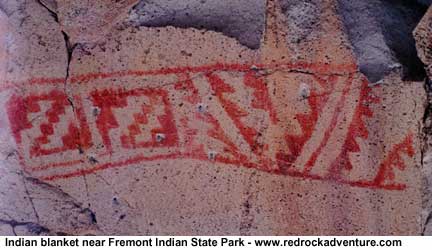
Indian Blanket Pictograph
At Fremont Indian State Park
By Dave Webb
See our photos from Fremont Indian State Park
 There
are many areas throughout Utah where you can view ancient Indian rock
art. In a few spots you can see the art from highways, if you look closely.
But — for the most part — the artwork is small and blends with
background rock, making it difficult tos see. Many people who drive our
byways are not even aware it is there. There
are many areas throughout Utah where you can view ancient Indian rock
art. In a few spots you can see the art from highways, if you look closely.
But — for the most part — the artwork is small and blends with
background rock, making it difficult tos see. Many people who drive our
byways are not even aware it is there.
That's the case along I-70, southwest of Richfield.
In the lower end of Clear Creek Canyon, around Fremont Indian State Park,
there are numerous rock art figures that can be seen by careful observers.
They're difficult to see when you're zipping along at freeway speed, but
you can see them easily if you get on the frontage road and drive slowly,
studying the rock panels.
There is one large pictograph which can be seen
easily from the freeway, even when traveling at high speed, if you look
in the right spot. It's located across the freeway from the park, near
the east entrance. It depicts an Indian blanket painted on a rock panel
several hundred feet up the mountainside.
The rangers at the state park tell the following
story about the pictograph, attributing the story to an area resident
who heard it when she was a little girl:
Many years ago there was a group of Indians
passing through what is now called Clear Creek Canyon, on the way to
their winter camping area. While they were in the canyon the new baby
of a young Indian woman died, and was buried near the site of the blanket
pictograph.
During the winter the young mother could not
get the thought of the baby, alone in the cold, out of her mind. The
next spring she made preparations and returned to Clear Creek Canyon
and painted a blanket on the rock to keep her lost by baby warm during
the cold winters.
Thre is an amazing concerntration of ancient Fremont
Indian rock art and archaeological sites in the area. A thriving village
existed there. I-70 was bulldozed right through the heart of the village,
destroying many sites. Fremont Indian State Park was established in an
effort to preserve the rest.
There's a wonderful museum at the park. Park rangers
guide visitors along trails around the visitor center, pointing out rock
art and helping visitors understand what significance it may have had
for its creators. It's worth taking the guided tour. The park also provides
pamphlets to help hikers find sites away from the visitor center.
The Indian blanket is classified as a pictograph
because it was painted onto the rock surface. The redish-orange pigment
used for the painting has obviously faded a bit over time but it is still
surprisingly vivid.
Most of the rock art figures in the area are classified
as petroglyphs because they were carved into the rock. The rocks in the
canyon develop a dark "desert varnish" on their surface, caused by minerals
in the rock oxidizing. When the dark surface is chiseled away the lighter
stone shows through, allowing the artist to crease a design which is visible.
It must have been tedious work, chipping away the rock to create an intricuate
design.
For most of 1,000 years the ancient sites in the
canyon survived with little deterioration. But much damage has been done
during the last few decades. You can see modern images carved by vandals
over ancient ones in many areas. In the blanket pictograph you can see
holes where its been shot by high-powered rifles. Some archaeologists
fear the rock art may be almost completely destroyed within 100 years.
What a shame.
When you visit this canyon, or others with ancient
sites, be sure you don't contribute to the problem. Don't climb on the
rocks or touch the figures. Many of the rocks crumble easily — you
could destroy the art and also hurt yourself. Oil from your fingers contributes
to the destruction of the artwork.
Hike on designated trails, and obey park rules.
Fremont in a fun place. Lets keep it that way.
For information contact Fremont Indian State Park,
(801) 527-4631.
Copyright Dave Webb, 2005
|

